Pricing Page Teardown: Perplexity
Welcome to the ongoing series of valueIQ’s Pricing Page Teardowns


Previous pricing page teardowns include:
In these teardowns, we use the valueIQ Pricing Intelligence agent to look at the pricing pages of well-known companies to see what we can learn.
Our next example is Perplexity. Perplexity is a generative AI search and research platform that gives you access to multiple Large Language Models. It has three modes: Search, Deep Research and the ability to Create Files and Apps (what used to be called Labs).
The bet here is that no one Large Language Model will dominate and that you will want access to multiple models, depending on what you are doing, and to compare the outputs of different models. This is essential functionality for any serious user (You.com’s chat function is an alternative).
You can get the Advanced Report on Perplexity’s pricing page by going to the Pricing Intelligence Agent, signing up, and easily searching for Perplexity. The free plan gives you 200 credits per month, so you can download the Advanced Report for Perplexity (Advanced Reports cost 120 Credits, Standard Reports cost 30 Credits).
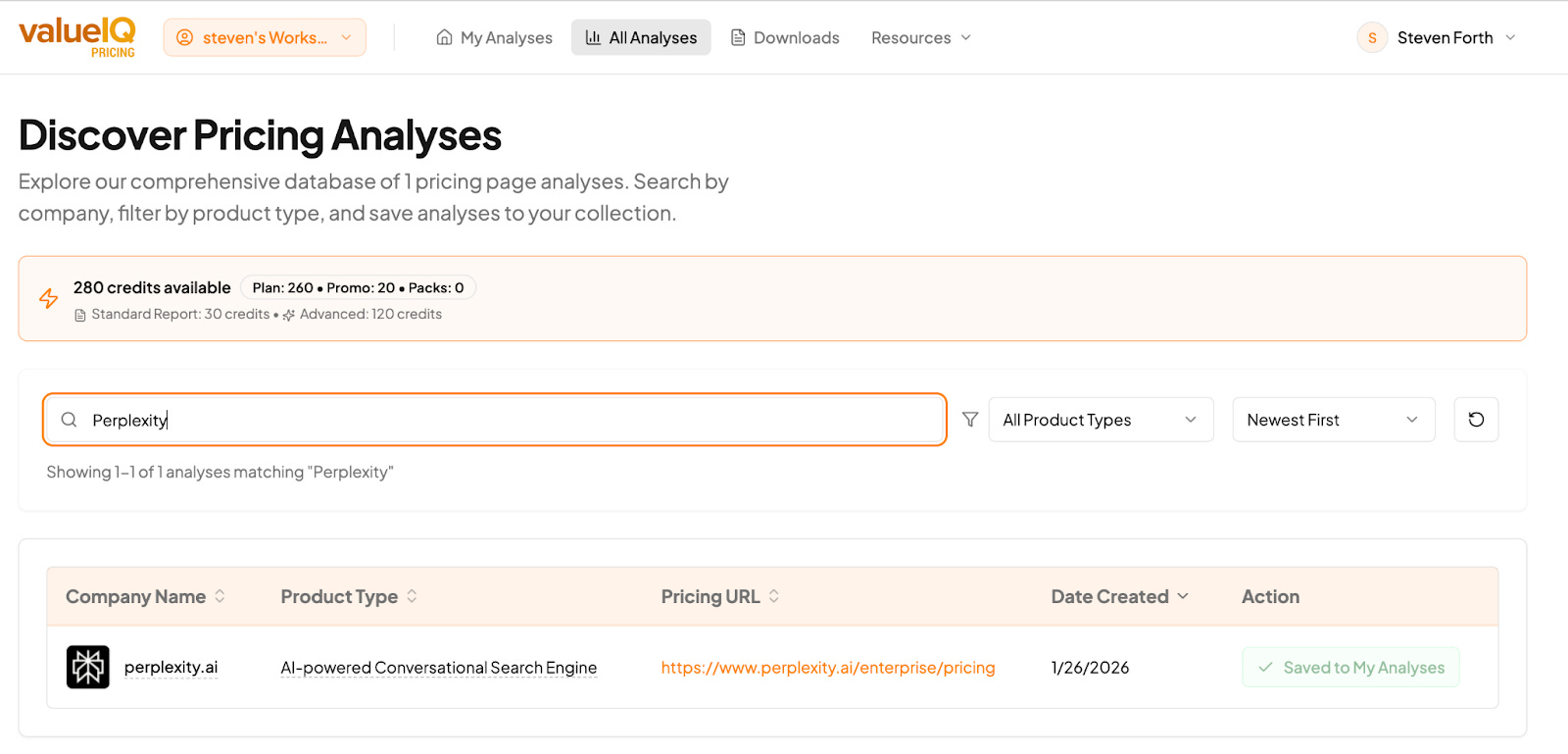
We generate the report by running the Perplexity Pricing Page through the Pricing Intelligence agent. It calls a number of sub-agents that work together to build a deep understanding of Lovable’s pricing, as shown by its pricing page, in a broader context.
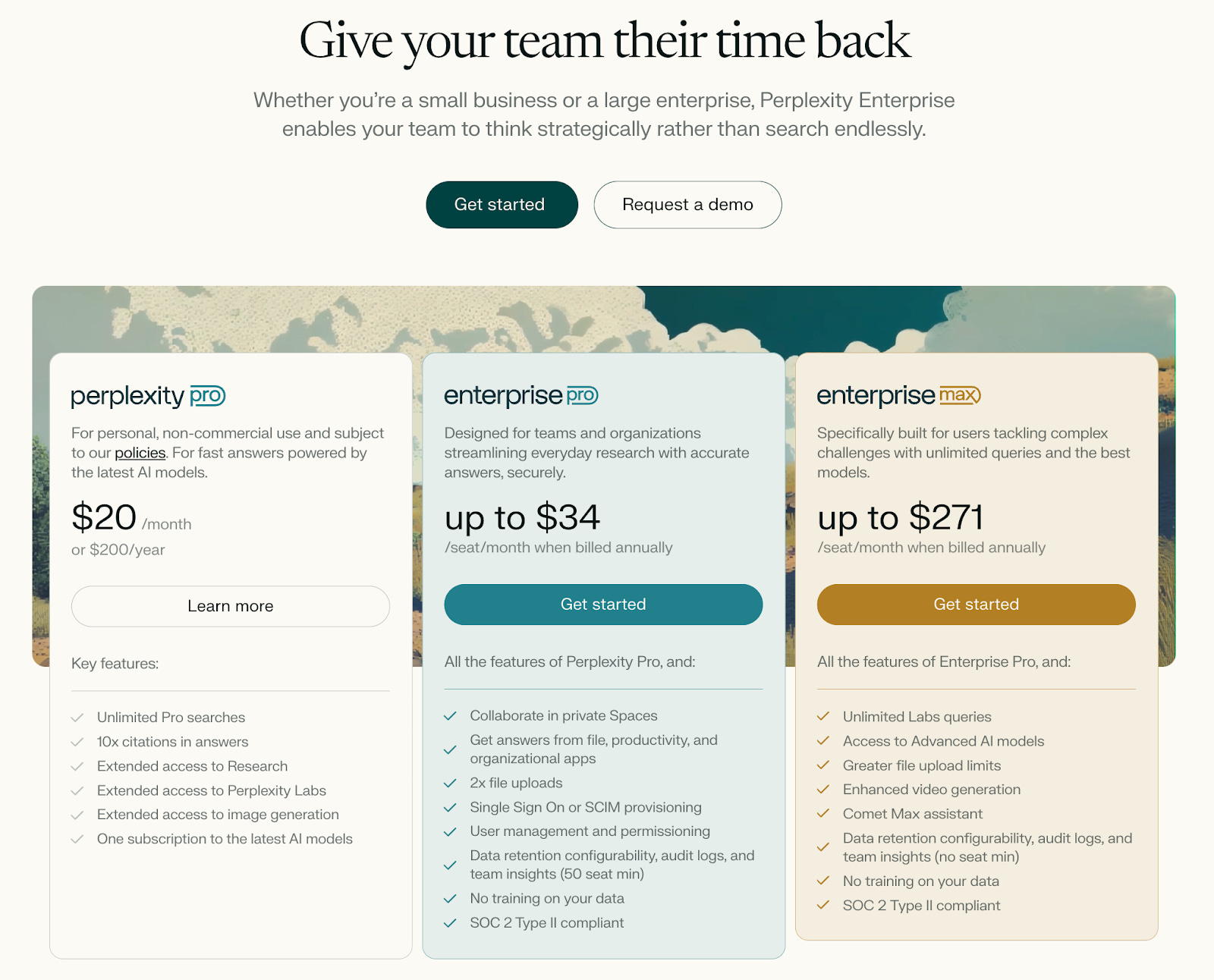
Perplexity uses a conventional per-user pricing metric with the now standard three-tier (GBB) pricing model, with a combination of capacity (number of Labs queries), functionality (collaboration), and privacy (no training on your data) fences.
See You’s pricing for a close comparison.
Results of the analysis
So what did the pricing page analysis find? Here are a few of the key sections from the Advanced report.
Pricing architecture (today)
(All list prices in this section are Observed Data from current public pricing, using monthly billing as the primary unit; effective monthly rates for annual billing are Modeled Estimates calculated as annual price ÷ 12.)
Pro (entry / small-org)
Metric: flat per-organization.
Price: $20 per org per month;
$200 per org per year (~$16.7/org-month).
Entitlements (examples, Observed Data): 20 research queries/day, 50 Labs queries/month, 3 videos/month, 5 collaborators per Space, 50 files/Space, files <50MB.
Enterprise Pro (core enterprise seat)
Metric: per seat.
Price: $40 per seat per month;
$400 per seat per year (~$33.3/seat-month).
Entitlements (Observed Data):
500 research queries/day, 50 Labs queries/month, 5 videos/month, unlimited collaborators, and higher file and repository caps.
Enterprise Max (power-user seat)
Metric: per seat.
Price: $325 per seat per month; $3,250 per seat per year (~$270.8/seat-month).
Entitlements (Observed Data): unlimited research queries, unlimited Labs queries, 15 high-quality videos/month, highest file caps, and advanced models.
Competitive position (pricing-only lens)
(All competitor prices and ranges in this paragraph and the next table are Observed Data for standard business/enterprise assistant tiers, normalized to $/seat-month.)
Mainstream enterprise assistant tiers cluster around $20–$40 per seat per month.
Examples: ChatGPT Business (~$25/seat-month annual), Claude Team Standard (~$25330), Microsoft 365 Copilot ($30), Gemini for Workspace Business/Enterprise (~$20330).
Research-specialist tools like Elicit Team sit higher (~$65/seat-month).
Perplexity Enterprise Pro at $40/seat-month is at the top of the mainstream band; Enterprise Max at $325/seat-month plays as a clear power-user tier, in line with other vendors’ premium seats
Reasons why this matters
The market has converged on per-seat pricing and suite bundling at $20–30/seat-month for many buyers (Observed Data).
Perplexity is intentionally premium on Enterprise Pro and very premium on Max, but the flat Pro org plan and undefined behavior at usage caps (Assumption: current policies are not fully codified or public) create friction and perceived risk.
Without tightening Pro’s role and making usage economics transparent, Perplexity risks losing deals on predictability and fairness, even when product value is strong.
Market Shift
Several shifts make pricing a board-level issue now:
Standardization on per-seat models.
Enterprise buyers now expect assistant tools to be priced per user per month, with bundled “generous usage.” Perplexity’s Enterprise tiers align; the Pro per-org plan is the structural outlier. Suite bundling pressure. Microsoft 365 Copilot (~$30/seat-month) and Gemini for Workspace (~$20–30/seat-month) are increasingly sold as add-ons to existing contracts (Observed Data). This reframes standalone assistants like Perplexity as incremental spend that must clearly outperform “already paid for” tools.
Premium but crowded middle band.
With many strong assistants at $20– 30/seat-month, Perplexity’s $40/seat-month Enterprise Pro must justify its premium in hard economic terms, not just qualitative claims.
Governance expectations as table stakes.
SOC 2, SSO, SCIM, and non-training commitments are now expected rather than differentiators. Buyers want predictable TCO and explicit usage policies, not just security badges. Together, these shifts mean pricing clarity, fairness, and ROI proof are now as important as model quality in determining enterprise wins.
Pricing SWOT
Most people are familiar with a SWOT analysis (Strengths, Weaknesses, Opportunities, Threats). The Pricing Intelligence agent generates a Pricing SWOT that narrows the focus to pricing issues.
Strengths
Clear good–better–best ladder (Pro → Enterprise Pro → Max) with strong per-seat anchor on Enterprise tiers.
Explicitly stated research/Labs/video caps and “unlimited” entitlements make value legible vs vague competitors.
High measurability and revenue predictability: orgs and seats are easy to count and bill.
Weaknesses
Hybrid metric: flat-org Pro vs per-seat Enterprise introduces confusion and value misalignment.
Enterprise Pro sits at the top of the mainstream price band, inviting benchmark-driven discount pressure.
Opaque runtime behavior at caps and unqualified “unlimited” for Max creates trust and cost-predictability issues.
Opportunities
Reposition Pro as entry/small-team and build migration ramps to unlock under-monetized customers.
Use quantified ROI, case studies, and tools to justify premium vs 20–30 per-seat assistants and standalones.
Differentiate via transparent policies and admin tools (seat-mix planning, usage visibility) instead of price cuts.
Threats
Suite bundling (Copilot, Gemini) framing Perplexity as redundant incremental spend.
Ongoing price competition from 20–30 per seat standalones (ChatGPT Business, Claude Team Standard).
Margins erode if Max usage grows faster than pricing and internal guardrails.
One way to use the SWOT is to combine strengths with opportunities and weaknesses with threats.
Strengths + Opportunities
Move Pro to be the on-ramp for Enterprise
Use the clear good–better–best ladder (Pro → Enterprise Pro → Max) to intentionally position Pro as the entry point for individuals and small teams, then guide successful users into Enterprise Pro and Max as they scale.
Design in-product nudges, usage thresholds, and team-collaboration prompts that suggest upgrading when organizations need shared workspaces, security, and centralized billing.
Monetize transparency and measurability instead of discounting
Leverage high measurability of orgs and seats to sell “predictable value” packages (clear per-seat pricing, visible limits, and ROI dashboards) rather than cutting list prices.
Combine this with transparent caps and entitlements messaging to differentiate from vague competitors and to justify staying at the top of the price band.
Build a “trust-first” enterprise positioning
Turn currently opaque runtime behavior and ambiguous “unlimited” language into an explicit advantage by publishing clear policies on rate limits, overages, and Max usage expectations.
Pair these policies with admin tools for seat-mix planning and usage visibility so buyers feel they can safely adopt higher tiers without unpredictable spend.
Use quantified ROI to unlock under-monetized customers
Take advantage of strong measurability to generate quantified ROI benchmarks and case studies for different roles and verticals, then use them in sales materials and in-product calculators.
Aim these assets at small teams and mid-market orgs that are under-monetized today, helping them justify moving from Pro or individual seats into Enterprise tiers.
Differentiate against bundled suites
Emphasize the clarity of the tiered ladder and transparent entitlements to stand apart from suite bundles that make Perplexity look like “extra” spend.
Position Enterprise Pro and Max as the best way to get predictable, high-impact AI assistance across a whole organization without the lock‑in or complexity of broader productivity suites.
Weaknesses + Threats
Perplexity faces pricing, positioning, and trust-related risks that could weaken growth and margins.
Pricing and value misalignment risks
The hybrid model (flat-org Pro vs per-seat Enterprise) risks confusing buyers and making it hard to compare value across tiers, which can slow or derail sales cycles.
Enterprise Pro and Max sit at the top end of the mainstream price band, while many competitors cluster around 20–30 per user per month, increasing discount pressure and churn risk when budgets tighten.
Trust and cost predictability risks
Opaque runtime behavior at usage caps and loosely defined “unlimited” entitlements for Max can erode customer trust if users experience throttling, denials, or unexpected limits.
Limited visibility into true usage and spend makes it harder for finance and IT buyers to forecast costs, which may push them toward alternatives with clearer, metered models.
Competitive and substitution risks
Suite bundling from Copilot, Gemini, and similar platforms can frame Perplexity as redundant incremental spend, especially when those suites are already purchased for office productivity or cloud credits.
Ongoing price competition from standalone assistants (ChatGPT, Claude, others) around the same price points can trigger race-to-the-bottom pricing or force Perplexity to add costly features to maintain differentiation.
Margin and usage-mix risks
If Max or other high-usage tiers grow faster than price increases or internal guardrails, infrastructure and model costs may outpace revenue per seat, compressing unit margins.
Heavy research or Labs usage from a subset of power users could create an unfavorable cost mix within “unlimited” plans, effectively subsidized by lighter users and weakening profitability.
Mansard COMPASS Analysis
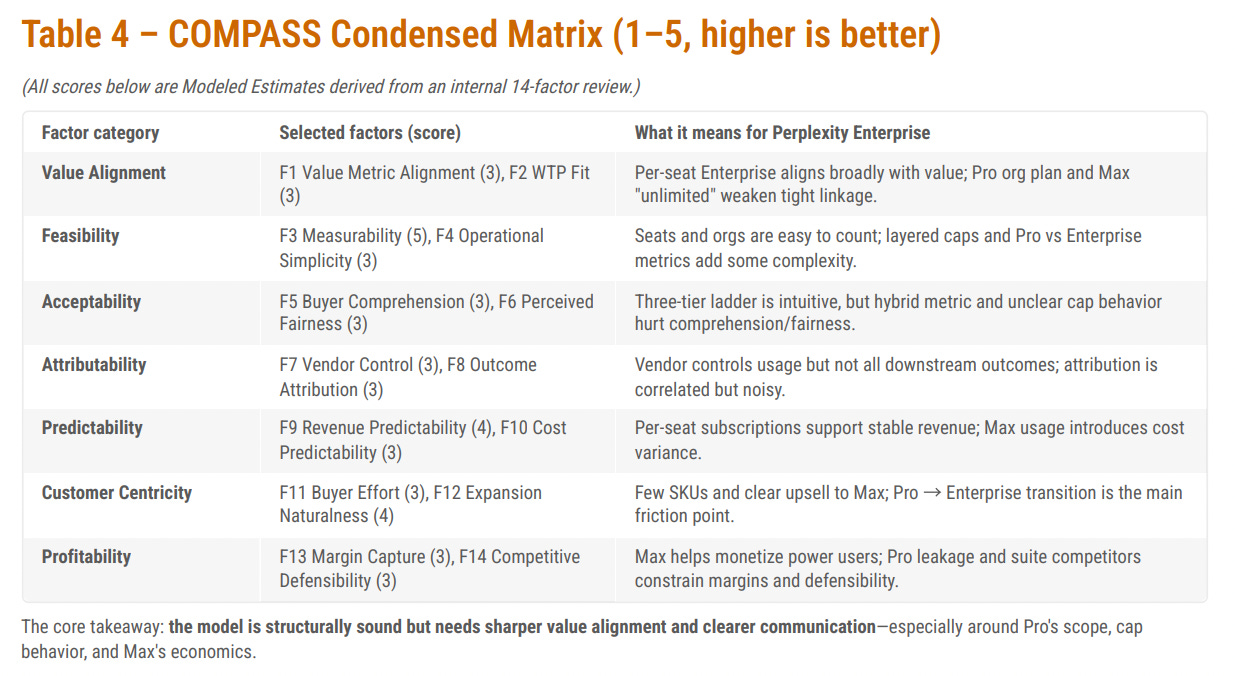
Here is a condensed version of the COMPASS matrix. The full version, available in the report, includes all 14 COMPASS attributes.
COMPASS (Choice of Optimal Metrics for Pricing Agentic Systems & Solutions).
COMPASS is a framework developed by Michael Mansard from Zuora and Steven Forth from valueIQ.ai to help companies navigate AI pricing. One of the Pricing Intelligence sub-agents is built around this framework.
For more on COMPASS, see The ‘COMPASS’ Agentic AI Pricing Metric framework: Your 2-Part Monetization Survival Guide to the Autonomous Age.
Other generative AI search and research companies to explore
To get more perspective, you may also want to run the pricing pages of other LLMs and compare them.
Other alternatives, such as Poe.com, do not have transparent pricing, so pricing cannot be analyzed based on public data.
Table of Contents for the Advanced Report
Part 1: Snapshot of Current State of Pricing1.
Part 2: Strategic Imperative.
2a. Strategic Imperative
2b. Market Shift
2c. Pricing Gap / Value Capture
Part 3: Value Architecture.
3a. How Value is Created
3b. Current Value Capture / Misalignment
3c. COMPASS Assessment .
Part 4: Pricing Framework and Competitive Positioning
4a. Tier Strategy & Positioning
4b. Competitive Positioning Map
Part 5: Pricing SWOT.
Appendices.
Appendix 1: Mansard 14-Factor Assessment
Appendix 2: Value Model (EVE) Summary
Appendix 3: Value Capture by Segment & Use Case
Appendix 4: Pricing Model & Price Curves
Want to see Pricing Intelligence in action? Every new user gets 200 Free Credits. Advanced Reports are 120 Credits, and Standard Reports are 30 Credits.