Pricing Page Teardown: Demodesk
Demodesk: Revenue Growth with AI Sales Agents

Enterprise‑Grade AI, Mid‑Market Budget: Where Demodesk’s Pricing Page Nails It, and Where It Blinks
Overview:
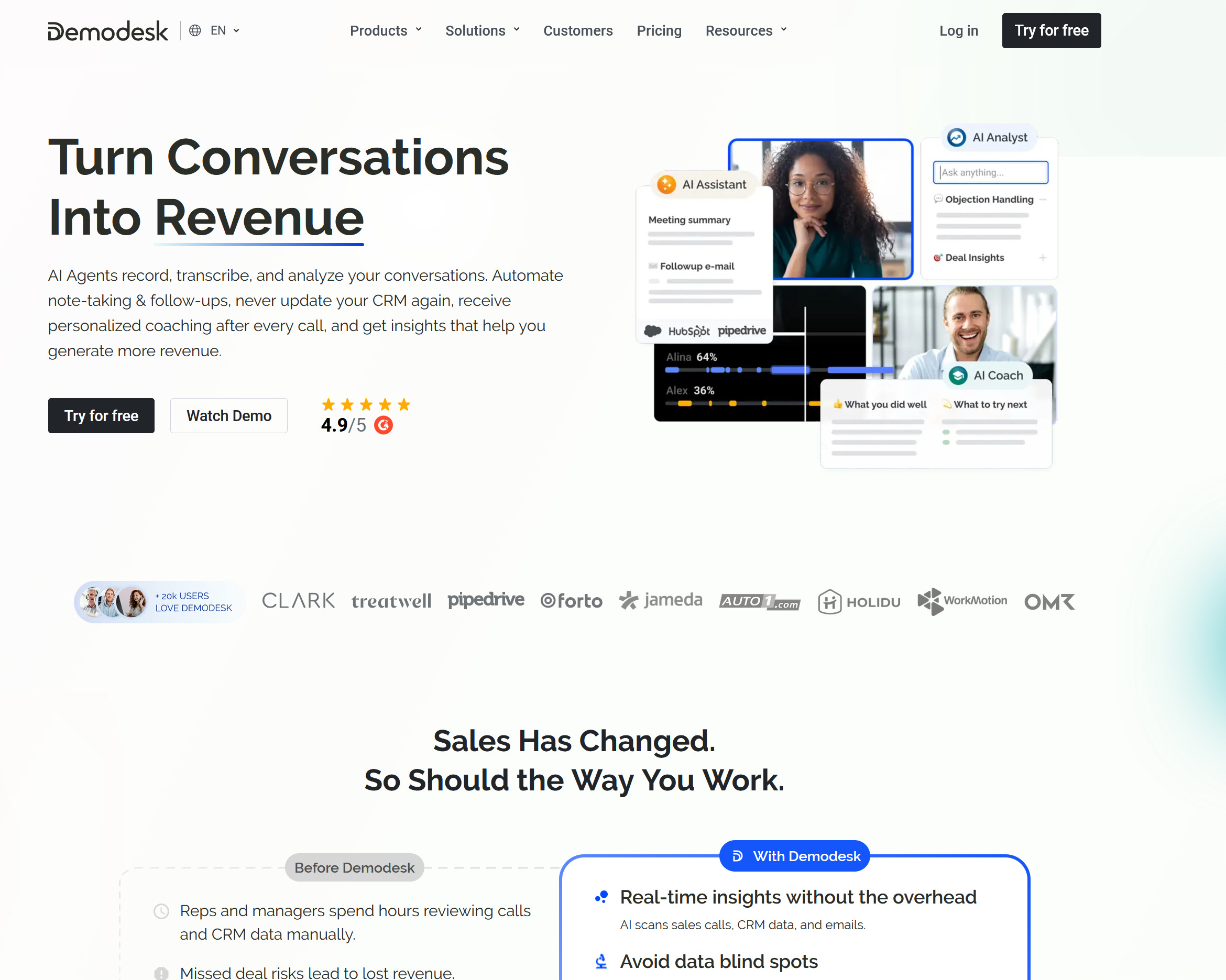
Demodesk builds AI sales agents that record, transcribe, and analyze conversations so reps and managers can stop living in call recordings and CRM updates, and start focusing on coaching, deals, and strategy. AI scans sales calls, CRM data, and emails to surface trends in objections, win rates, and customer sentiment, while GDPR‑compliant controls govern what gets recorded, who can see it, and how it’s used.
The promise to revenue teams is simple: more revenue, less overhead, by replacing multiple point solutions with a single, configurable AI platform that works in 98 languages and fits existing workflows.
Demodesk sits in one of the toughest corners of B2B software: conversation intelligence and AI‑powered sales coaching. It’s selling into teams with 10–100+ sellers who are already overwhelmed by tools, stretched budgets, and “platform” promises that rarely match reality.
In our advanced pricing strategy work for their pricing page, Demodesk has a clear ambition: enterprise‑grade AI without enterprise‑grade platform fees.
We ran Demodesk’s pricing page with valueIQ’s Pricing Intelligence tool for a Standard (30 Credits) and an Advanced (120 Credits) report. Generated in under 30 minutes.
In plain language, that means:
Competing with Gong and Chorus on capability.
Without copying their platform fee + opaque bundle pricing.
While still charging more (and delivering more) than lightweight assistants like Fireflies or tl;dv.
Look at the category, and you can see why this positioning matters.
At one end, you’ve got Gong/Chorus: platform fees, per‑seat contracts, annual‑only, and very little public pricing detail.
At the other end, cheaper tools with transparent ladders and simple metering, but less depth in coaching analytics, governance, and pipeline insights.
Demodesk wants to live in the middle: mid price, high capability, no platform tax. The goal is to feel like “Gong‑level AI on a mid‑market budget,” especially for 10–50 seat teams.
The question our teardown asks is simple:
If that’s the promise, does the pricing page actually deliver it? Or does it start to drift back toward the enterprise‑grade pricing pain buyers are trying to escape?
What “Enterprise‑Grade Without Enterprise‑Grade Platform Fees” Should Look Like on a Pricing Page
Before we teardown Demodesk’s pricing page, we need a fair benchmark. What should “enterprise‑grade AI without enterprise‑grade platform fees” look like when it hits the pricing table?
From Demodesk’s own competitive positioning work, a few concrete expectations emerge.
No platform fee, no mystery “implementation” line item
A mid‑market buyer should be able to explain Demodesk’s core pricing model in one sentence:
“We pay per recording user, viewers are free, and there’s no separate platform tax.”Clear per‑seat economics from 1 to ~100 recording users
The jump from 10 to 30 to 80 seats shouldn’t require a separate spreadsheet, much less a full procurement cycle, just to understand the basics. A RevOps lead should be able to sketch the total monthly cost in five minutes.Free viewers as baseline, not a moat
“Recorders pay, viewers free” is quickly becoming the default in this space. It’s important for adoption, but it’s no longer a differentiator on its own.Enough enterprise and add‑on structure that TCO is predictable
Mid‑market buyers are tired of discovering later that SSO, long‑term retention, premium support, or a dedicated AM quietly doubles their total cost. For a company claiming “no platform fee” and mid‑market friendliness, the pricing page needs to show:What happens at the 30+ seat enterprise break?
How data retention is priced beyond the default 90 days.
How governance features are packaged—as options they can reason about, not surprises they discover late in the cycle.
That’s the bar Demodesk has set for itself. In the rest of this teardown, we’ll look at where the current pricing page architecture supports this promise, and where it still pulls Demodesk back toward the very platform‑fee world it wants to differentiate from.
Part 1 – Core Structure vs the Promise
At first glance, Demodesk’s pricing architecture does a lot of things right for a company chasing “enterprise‑grade AI on a mid‑market budget.”
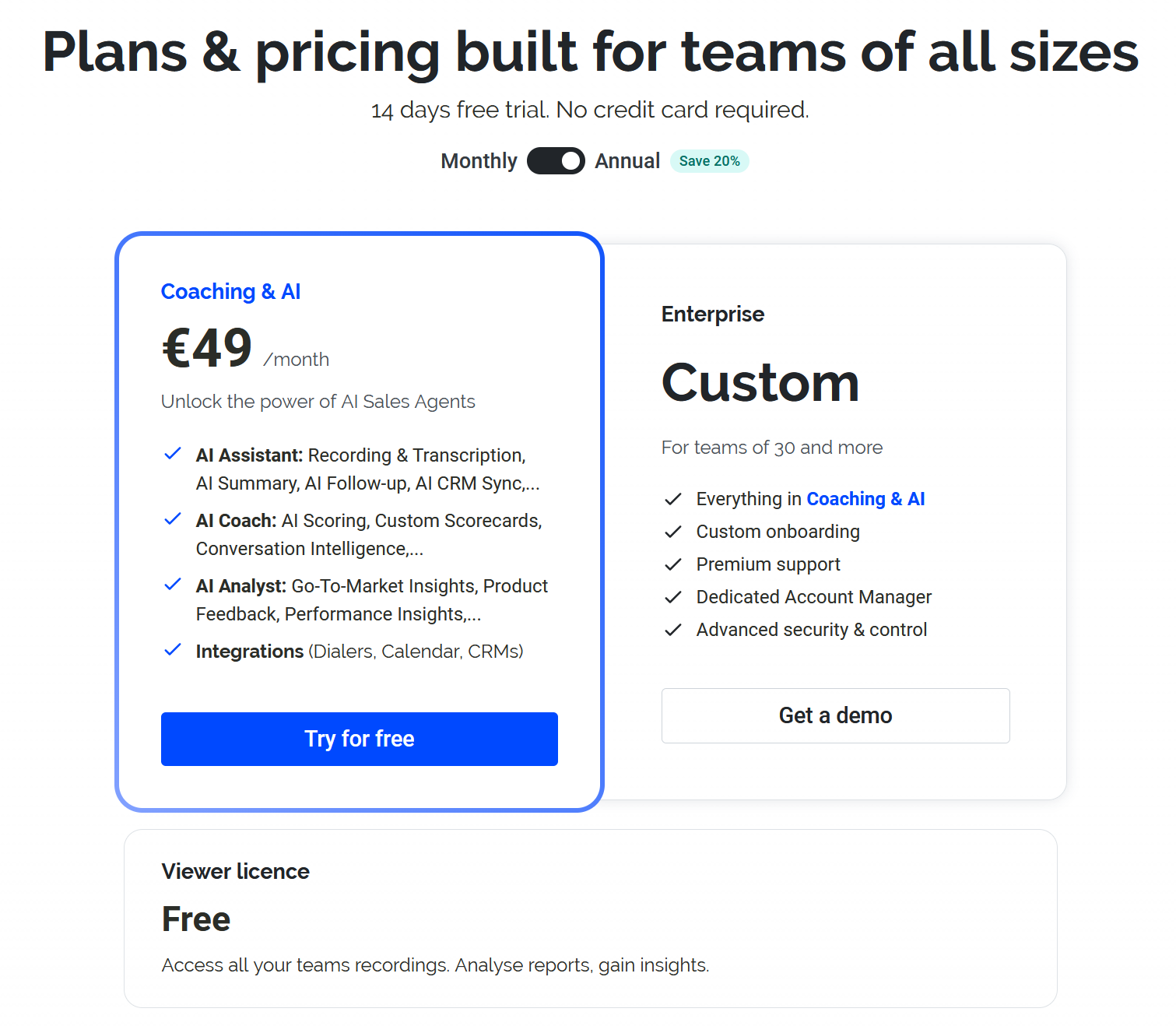
The public model is simple:
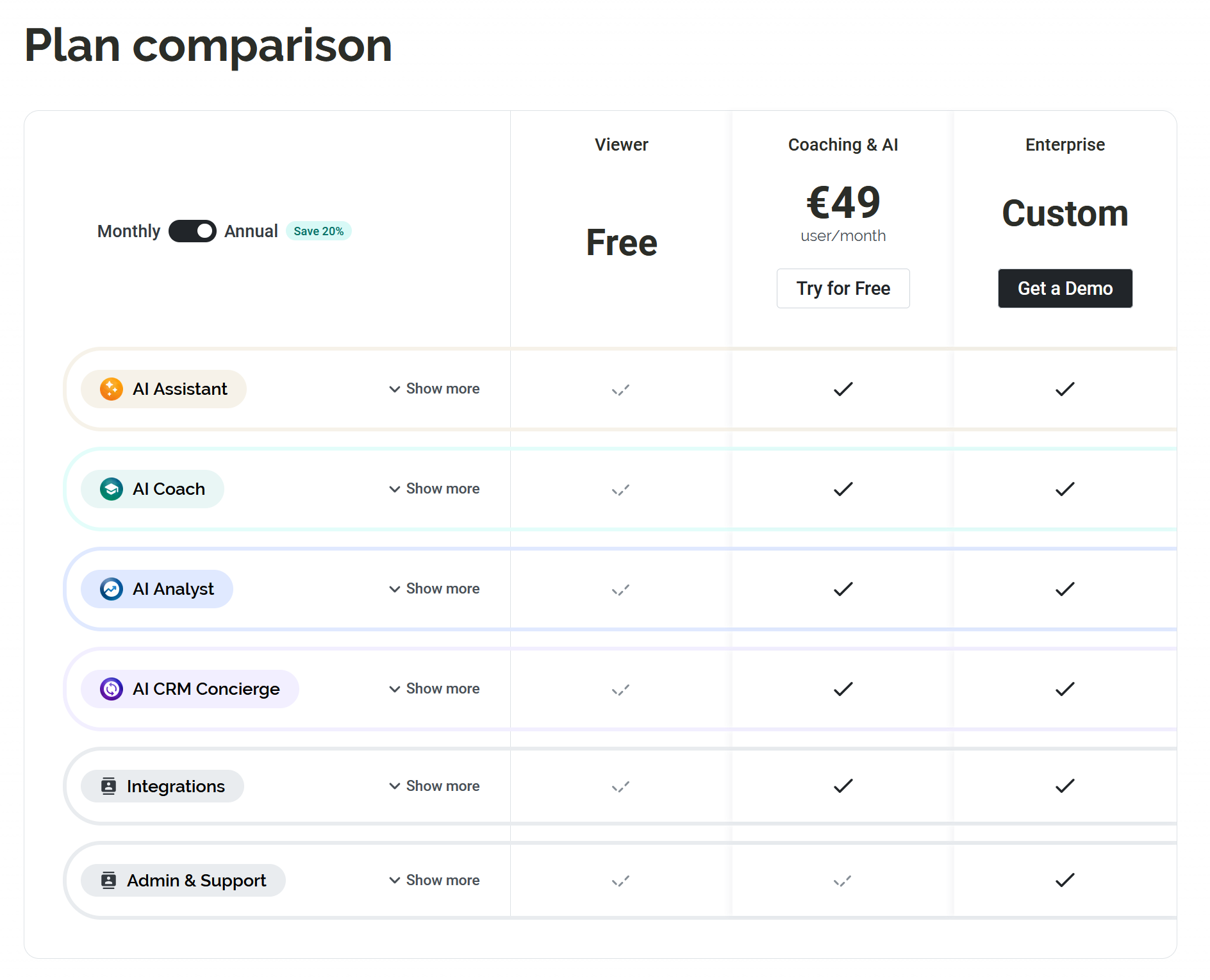
Viewer – €0 per user_seat_month
Read‑only, non‑recording access to meetings and insights.
Coaching & AI – €49 per user_seat_month on monthly billing, ~€39 on annual (“Save 20%”)
Recording, transcription/translation, AI summaries and follow‑up, AI CRM filling, coaching analytics, deal and pipeline insights, go‑to‑market, and product feedback.
Enterprise (30+ users) – still priced per user_seat_month, but fully custom
Everything in Coaching & AI, plus enterprise onboarding, premium support, dedicated AM, advanced security, and control.
That skeleton matters. In a world of platform fees and multi‑line quotes, Demodesk’s decision to anchor everything on a single, understandable metric — the user seat month - is a real asset. COMPASS and the Michael Mansard assessment both point in the same direction:
Value Metric Alignment at 3/5: seats are directionally right for how value scales.
Measurability at 5/5 and Feasibility at 4/5: easy to meter, easy to bill, easy to explain.
For a 10–50 seat team, the message is clear:
No platform fee.
One main tier (Coaching & AI) with a clear list price and an obvious annual discount.
Free Viewers so everyone can see insights without fighting over licenses.
This is exactly the kind of structure mid‑market buyers say they want when they’re trying to avoid Gong‑style complexity: a clean per‑seat ladder, a credible “standard” tier for most users, and a free “everyone sees the truth” layer on top.
So, at the level of architecture, Demodesk is much closer to the “enterprise‑grade without enterprise‑grade platform fees” promise than many of its peers. The foundation is not the problem.
The tension shows up when you move past the headline tiers and start asking harder questions about add‑ons, enterprise economics, and how well the pricing story tracks where value and cost actually live. That’s where the shadow of the old platform world begins to creep in.
Part 2 – Transparency & Add‑Ons: Where the Gong Shadow Creeps In
The first crack in the story appears when you look at what isn’t clearly priced.
Demodesk’s pricing report lists several important add‑ons and enterprise features:
Premium support.
Sales enablement support.
Dedicated account management.
Custom workflows.
SSO and advanced security & control.
Extended recording retention up to 10 years (with only 90 days included by default).
On the public pricing side, these show up as “included in Enterprise” or “available as add‑ons,” but without visible structure or guardrails. The net effect for a 30–80 seat buyer is uncertainty on three fronts:
How much more expensive do we get if we need multi‑year retention?
What’s the real TCO if we need SSO, premium support, and a dedicated AM (which most serious deployments will)?
Once we cross the 30‑seat threshold into Enterprise, are we still on a mid‑market‑friendly curve—or are we in Gong territory with everything negotiable and nothing predictable?
The quiet part out loud:
Buyers are increasingly hostile to opaque add‑ons and quote‑only enterprise pricing.
Demodesk’s Enterprise and retention economics are largely hidden.
Add‑on accretion and unclear retention fees create bill‑shock risk.
This is exactly the pattern mid‑market buyers are trying to escape when they say they’re done with platform fees and sprawling bundles. When they hear “enterprise‑grade AI without enterprise‑grade platform fees,” they’re really hoping it also means “no surprise add‑on tax buried in the enterprise column.”
Right now, Demodesk is halfway there. The core seat price is clear. The existence of key add‑ons is clear. But the economics of those add‑ons—and the enterprise bands they live in—are still concealed behind “contact us.”
From the outside, that looks and feels a lot like the world Gong built.
Part 3 – Value Capture & Fairness: A Quietly Generous Model with a Muffled Story
Under the hood, Demodesk’s pricing model is more generous than the page suggests.
The value model (EVE) in the advanced report outlines the indicative economic value per user_seat_month by segment:
Small teams (<10 sellers): roughly €50–150 in economic value from time savings and modest performance gains.
Mid‑market (10–50 sellers): €150–300+ from ramp speed, win‑rate lift, and forecast accuracy improvements.
Enterprise (50+ sellers): €200–400+ when CI/RI is programmatic and global, with compliance‑grade retention.
Against that, you’ve got a €49 monthly / ~€39 annual price point for Coaching & AI, and often similar baselines for enterprise seats. The implied value capture:
Small teams: ~25–100% of value, depending on usage and outcomes.
Mid‑market: ~15–35%.
Enterprise: ~10–30%, excluding whatever is captured through opaque add‑ons.
That’s a healthy amount of buyer surplus, especially in mid‑market and enterprise accounts where the behavioral impact of coaching and CI/RI is real.
The misalignment creeps in on two fronts:
Usage intensity variance
Within the same 20‑seat team, some managers and RevOps users may analyze far more meetings and insights than light ICs, yet everyone pays the same €39–49 per user_seat_month. This can trigger internal fairness debates (“who deserves a seat?”) and slow full‑team rollout.Cost vs revenue for heavy retention/usage
Accounts that record many long meetings and extend retention to years can generate disproportionately high compute and storage costs while still paying a flat per‑seat fee plus an undefined retention add‑on.
COMPASS summarises it bluntly:
Value Alignment: 3.0 – seats are directionally right, but loose versus meetings, retention, and AI intensity.
Acceptability: 3.0 – core seat price feels fair; opaque add‑ons and enterprise reduce perceived fairness.
Profitability: 2.5 – reasonable baseline, but weak margin capture for AI‑intensive and long‑retention accounts.
In other words:
Demodesk’s numbers are generous enough that you could tell a strong value story.
But the current pricing page doesn’t help buyers see that story—or understand when and why they might pay more.
For a positioning built on “enterprise‑grade without enterprise‑grade platform fees,” that’s a missed opportunity.
The Fix – How to Actually Earn the “Enterprise‑Grade, No Platform Fee” Positioning
The good news is that Demodesk doesn’t need to rip out its model. The report’s own target‑state framework shows a path to earning the promise with the architecture it already has.
Here’s what that looks like when translated into pricing‑page moves.
Make the three tiers tell a sharper story
Viewer – “Everyone sees the truth”
Keep Viewers free, but spell out capabilities: view, search, comment, basic dashboards, no recording/hosting.
Coaching & AI – “Team‑wide AI coaching and insights”
Keep the €49 / ~€39 price points.
Explicitly frame this as the default tier for small and mid‑market teams: full AI assistant/coach/analyst feature set, 90‑day retention included.
Enterprise – “Governed CI/RI at scale”
Anchor the trigger at 30+ recording users.
Make it clear that this is about governance, retention, and cross‑functional programs, not just “more expensive seats.”
Publish retention tiers and logic
Name retention tiers (e.g., 90d, 1y, 3y, 7y, 10y) and show the incremental logic, even if enterprise pricing is still “starting at” by band.
This directly addresses the bill‑shock and TCO uncertainty your own analysis highlights.
Turn opaque add‑ons into visible bundles
Instead of listing SSO, premium support, dedicated AM, and custom workflows as loose add‑ons, assemble them into 1–2 standard enterprise bundles with visible differentials.
That preserves margin and room for upsell, but signals to buyers: “There are no hidden platform taxes here. You can see the structure.”
Add enterprise guardrails and “starting at” bands
For the 30–99 and 100+ recording user bands, publish “starting at” per‑seat ranges that align with your target price curve:
Modest discounts vs list for mid‑market volumes.
Deeper discounts at 100+ only when tied to multi‑year terms or higher retention tiers.
This makes it possible for a RevOps leader to sketch TCO without talking to sales—and reduces the temptation for uncontrolled discounting to flatten or invert the price curve.
Back it all with ROI guardrails, not gain‑share experiments
Rather than jumping to outcome‑based or gain‑share pricing (which your Mansard assessment rightly warns against), invest in a simple ROI program: benchmarks on ramp time, win‑rate, and forecast accuracy by segment.
This gives sales a way to defend price and retention tiers while keeping the pricing model understandable.
Put together, these changes don’t turn Demodesk into a different company. They make the pricing page catch up with the ambition.
The company already has a clean per‑seat model, a generous value story, and a credible “mid‑market hero” position in a messy category. The work now is to let the pricing page prove it—to mid‑market buyers, to enterprise procurement, and to anyone comparing Demodesk to Gong on one side and the low‑end assistants on the other.
Enterprise‑grade AI without enterprise‑grade platform fees is the right promise.
With a few targeted changes, Demodesk’s pricing page can finally sound as strong as the economics behind it.
Like what you see? Analyze any SaaS pricing page in the world with Pricing Intelligence.
Updating your pricing? Not sure where you stand and what’s working and what’s not?
It’s Free to Sign Up - No Credit Card Required.